Direct execution of design methods
In this section, you have access to a collection of powerful algorithms designed to improve your design experience. These algorithms offer detailed information and functionality to enrich your design process.
Algorithms
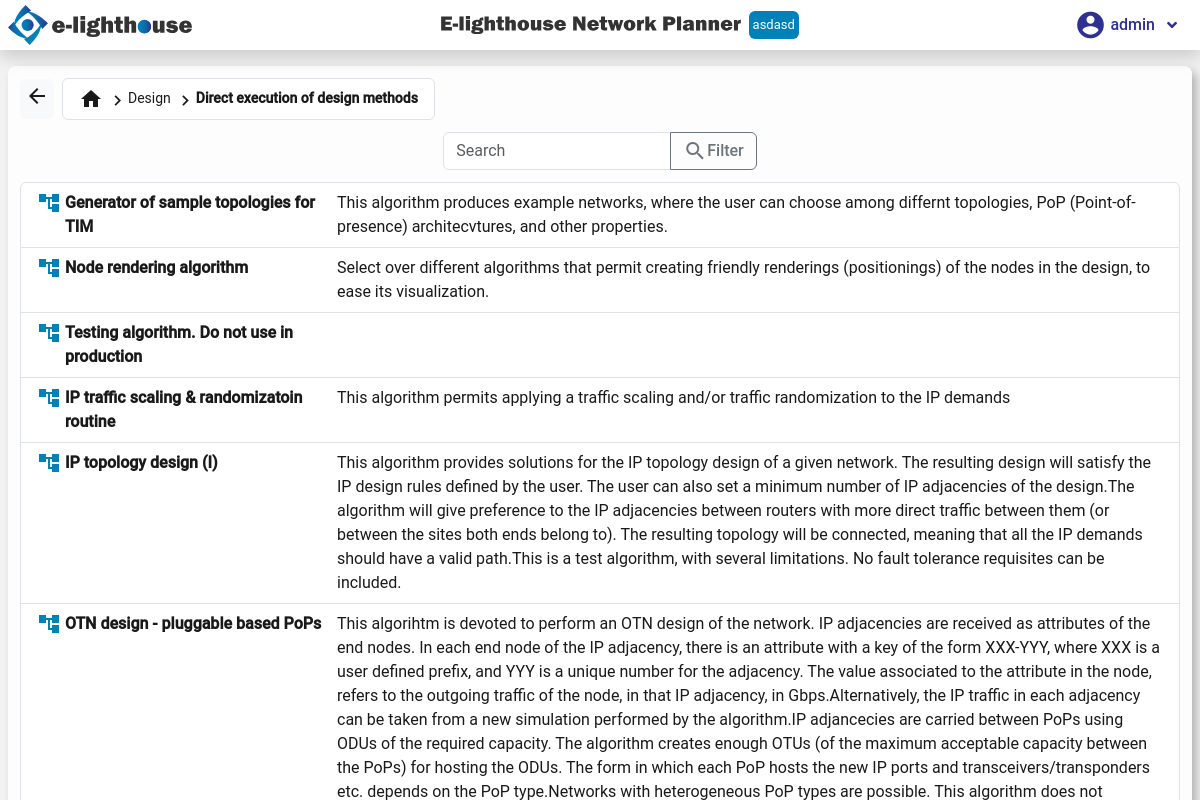
- Generator of sample topologies for TIM. This algorithm produces example networks, where the user can choose among differnt topologies, PoP (Point-of-presence) architecvtures, and other properties.
- Node rendering algorithm. Select over different algorithms that permit creating friendly renderings (positionings) of the nodes in the design, to ease its visualization.
- Testing algorithm. Do not use in production.
- IP traffic scaling & randomizatoin routine. This algorithm permits applying a traffic scaling and/or traffic randomization to the IP demands
- IP topology design (I). This algorithm provides solutions for the IP topology design of a given network. The resulting design will satisfy the IP design rules defined by the user. The user can also set a minimum number of IP adjacencies of the design.The algorithm will give preference to the IP adjacencies between routers with more direct traffic between them (or between the sites both ends belong to). The resulting topology will be connected, meaning that all the IP demands should have a valid path.This is a test algorithm, with several limitations. No fault tolerance requisites can be included.
- OTN design - pluggable based PoPs. This algorihtm is devoted to perform an OTN design of the network. IP adjacencies are received as attributes of the end nodes. In each end node of the IP adjacency, there is an attribute with a key of the form XXX-YYY, where XXX is a user defined prefix, and YYY is a unique number for the adjacency. The value associated to the attribute in the node, refers to the outgoing traffic of the node, in that IP adjacency, in Gbps.Alternatively, the IP traffic in each adjacency can be taken from a new simulation performed by the algorithm.IP adjancecies are carried between PoPs using ODUs of the required capacity. The algorithm creates enough OTUs (of the maximum acceptable capacity between the PoPs) for hosting the ODUs. The form in which each PoP hosts the new IP ports and transceivers/transponders etc. depends on the PoP type.Networks with heterogeneous PoP types are possible. This algorithm does not consider fault tolerance requirements for the output design
- OTN design - non-pluggable based PoPs. This algorihtm is devoted to perform an OTN design of the network. IP adjacencies are received as attributes of the end nodes. In each end node of the IP adjacency, there is an attribute with a key of the form XXX-YYY, where XXX is a user defined prefix, and YYY is a unique number for the adjacency. The value associated to the attribute in the node, refers to the outgoing traffic of the node, in that IP adjacency, in Gbps.Alternatively, the IP traffic in each adjacency can be taken from a new simulation performed by the algorithm.IP adjancecies are carried between PoPs using ODUs of the required capacity. The algorithm creates enough OTUs (of the maximum acceptable capacity between the PoPs) for hosting the ODUs. The form in which each PoP hosts the new IP ports and transceivers/transponders etc. depends on the PoP type.Networks with heterogeneous PoP types are possible. This algorithm does not consider fault tolerance requirements for the output design